Every Baltimore group making the DC run for a Capitals game, a Wizards playoff push, a Georgetown matchup, or a sold-out concert at Capital One Arena (601 F Street NW, Washington, DC 20004) already knows the short version of the problem: I-95 South during evening rush is a parking lot, Penn Quarter has almost no event parking, and rideshare surge pricing after a 10 p.m. final whistle is its own kind of punishment. What trips people up isn't the event — it's the 40-mile corridor between Baltimore and downtown DC, and what waits on the other side of it.
One question separates groups that enjoy the trip from groups that spend half of it arguing about who has to drive: how does the bus drop us at the door, and where does it wait until we walk out? This guide answers that question with verified specifics — the exact street where a bus drops off at Capital One Arena, where it stages during a three-hour event, what the Penn Quarter parking reality looks like on event nights, and what the return trip north looks like after a late finish. Fill out one quick form on this site or call 410-844-4136 any time to get pricing for your group's trip.
Why Baltimore Groups Rent a Charter Bus or Party Bus to Capital One Arena
The case for renting a bus from Baltimore to Capital One Arena isn't about comfort — it's about math. Penn Quarter sits in the middle of downtown Washington, and the arena's own parking garage is not open for Capitals or Wizards games; it's reserved for concerts only. That means every group driving from Baltimore has to compete for privately owned garage space scattered in a ring around the building, where event-night drive-up rates typically run $25 to $45 per car — and those garages start filling a full hour before tipoff on sold-out nights.
Put 10 people from Baltimore in three separate cars and you're already spending $75 to $135 just to park, before anyone sees the first faceoff.
Then there's the post-event reality. Capital One Arena draws 20,356 fans on a sellout basketball night and 18,573 on a full hockey house. When all of them hit the Penn Quarter sidewalks at the same moment, rideshare demand spikes hard.
A group of 15 waiting on 4 separate Lyfts on a Wednesday night in December, in 30-degree DC air, after a Capitals overtime finish, is a different experience than climbing onto one waiting bus.
A Baltimore party bus or charter bus rental to Capital One Arena cuts through all of it. One vehicle handles the drive down, the drop-off at the arena entrance, the wait during the event, and the direct run back up to Baltimore — for a single predictable rate split across everyone in the group. Check the Baltimore sporting event transportation page for more on how this works for group sports runs.
Charter Bus & Party Bus Drop-Off at Capital One Arena
Capital One Arena sits on the block bounded by F Street NW to the south, G Street NW to the north, 6th Street NW to the east, and 7th Street NW to the west. The arena's main public entrance faces F Street NW, which the city also names Abe Pollin Way in honor of the arena's founder — and that's the curb where most group buses drop off, between the 6th Street and 7th Street corners. The bus pulls to the F Street curb, your group walks straight through the main entrance, and the group is at the box office in under a minute.
The 7th Street NW side also has arena entrance points and is a viable drop-off lane; on event nights with heavy curbside competition on F Street, the 7th Street approach keeps the drop-off smooth. There is no dedicated charter bus pull-through lane at Capital One Arena — the drop zone is a standard city curb — so the timing and exact curb position for your specific event are confirmed when you book, based on what DC traffic is doing that night. Penn Quarter streets stay two-way in most sections, but expect slow-crawling event traffic on F Street and 7th Street in the 30 minutes before gates open and for 20 minutes after the final buzzer.
For the official venue address and any special event-night street changes, check the Capital One Arena directions and parking page before your visit — road closures for major events or Inauguration-related security perimeters can alter the standard approach.
Drop-off is on F Street NW (Abe Pollin Way), between 6th and 7th Streets — the arena's main-entrance curb. Your group walks in from the street, not from a parking garage three blocks away. That distinction is the whole reason a bus is worth it in Penn Quarter.
The Baltimore-to-Capital One Arena Drive: I-95 and What to Know
The standard Baltimore-to-Capital One Arena run covers roughly 40 miles via I-95 South. From downtown Baltimore or the Inner Harbor, the practical route is I-95 South to I-395 North into downtown DC, then surface streets through the Federal Triangle and Penn Quarter to the F Street drop. Off-peak — think a 6:30 p.m. weeknight puck drop on a Tuesday — the drive runs close to 45 to 55 minutes.
During Maryland evening rush (4 to 6:30 p.m. on weekdays), the same stretch can push past 90 minutes, particularly through the I-695 split near Arbutus and the I-95/I-495 interchange in College Park.
The Baltimore-Washington Parkway (MD-295) runs parallel to I-95 and looks tempting on the map — it's toll-free and a bit shorter in miles. The practical issue is that the National Park Service manages the southern section of the parkway, and that section prohibits commercial trucks. Buses are in a different regulatory category and are permitted on the parkway, but the road is two lanes in each direction with a 55 mph limit, no shoulders worth mentioning, and a reputation for incidents that back up for miles with no alternate exit.
The American Bus Association notes the parkway's commercial vehicle restrictions and advises operators to use the DDOT's Truck and Bus Map for routing into DC — and for a group running on an event-night timeline, I-95 offers more lanes, more predictability, and a more direct connection to the I-395 bridge into the city.
The I-395 approach into downtown is the cleanest line to Penn Quarter from the south. Exit at 9th Street NW or 12th Street NW depending on traffic, then work across the grid to F Street. Because DC streets around the Mall and Penn Quarter carry significant one-way and turn restrictions, the actual approach is confirmed for your specific event date when the trip is set up — some events trigger downtown security perimeters that change the routing.
Build in at least 90 minutes of buffer from Baltimore on any weekday evening event; for weekend afternoon games the drive is typically closer to 50 to 60 minutes.
Where Your Bus Stages During the Game or Show
This is the question groups always forget to ask, and it's the one that matters most for the post-event pickup. Capital One Arena has no designated charter bus staging area on site — the venue is a block of a dense urban grid, not a stadium surrounded by lots. The bus drops your group at the F Street curb and then has to move.
Circling Penn Quarter for two or three hours is not a practical option; DC's downtown grid is too congested and metered parking for an oversized vehicle is essentially unavailable.
The standard staging solution that groups use for Capital One Arena events is Union Station (50 Massachusetts Ave NE, Washington, DC 20002), approximately one mile northeast of the arena. Union Station operates a dedicated intercity bus deck with motorcoach spaces and has accommodated charter bus staging; the CharterUP motorcoach parking guide cites rates in the range of $60 off-peak to $75 during peak season per vehicle, and advance reservation of the bus deck space is required — you cannot simply pull in and wait. The bus deck operates separately from the main station terminal, and all loading and unloading must be done at the deck, not at the station's main entrance on Massachusetts Avenue.
With Union Station as the staging point, the logistics flow cleanly: your group agrees on a post-event meeting time and spot on F Street before walking in, the bus moves to Union Station after drop-off, and it returns to the arena's F Street curb for pickup when you send word the group is heading out. Allow a realistic buffer — after a sold-out event, it takes 15 to 20 minutes for the Penn Quarter grid to start moving again, and the bus needs time to pull back through the traffic. Setting the post-event pickup time about 20 to 25 minutes after the expected event end gives everyone room to breathe.
Set your post-event pickup location and time before the game starts. On a sellout night, F Street fills up fast when the final buzzer sounds. A clear rendezvous point — 6th and F Street, east corner — keeps 20 people from scattering across three blocks trying to find the bus.
Parking at Capital One Arena: What Every Group Should Know First
The single most important thing Baltimore groups learn about Capital One Arena parking: the arena's own garage, located beneath the building at 6th Street NW, is not open for Capitals or Wizards games. That garage is available for concerts only, opening 90 minutes before event time and closing one hour after the final act. For every hockey and basketball game, groups are competing for independently operated private garages in a three-to-ten-block radius around the building.
The closest option is the iParkit Penn Quarter Self-Park Garage, one block from the arena. Also frequently cited are multiple Colonial Parking locations and the Gallery Place Garage. On event nights, drive-up rates at the closest garages typically run $25 to $45 per car; for playoff games or high-demand concerts the range pushes higher.
Pre-booking through SpotHero's Capital One Arena page consistently runs cheaper than walk-up, but it doesn't change the fundamental reality: for 10 people arriving in multiple cars, you're looking at $250 to $450 in parking alone before a single ticket is scanned.
A single 56-passenger charter bus replaces that entire arithmetic. One vehicle, one staging arrangement, and the parking problem disappears completely — the group arrives at the F Street curb and walks in, while everyone who drove is circling the block looking for the last spot in a garage on 9th Street.
Getting to Capital One Arena from Baltimore: Every Option Compared
| Option | Cost shape | Group stays together? | Drop-off at arena? | Post-event return | Best for |
|---|---|---|---|---|---|
| Charter bus or party bus from Baltimore | One flat rate split by the group | Yes — one vehicle, one arrival | Yes — F Street curb at the main entrance | Bus stages at Union Station, returns to F Street on your schedule | 15–56 people; any event type |
| Drive & park in Penn Quarter | $25–$45/car walk-up, gas, tolls | No — group splits across cars | No — garage several blocks from entrance | Post-event gridlock, hunting for your garage exit | 1–2 cars max; not sold-out events |
| MARC Penn Line to Union Station + Metro | ~$9 each way per person + Metro fare | Only if booked same train | No — Metro to Gallery Place, then stairs up to street | Late-night weekend return is significantly limited; last weekend train departs early | Small group, weekday event with early finish |
| Rideshare (Uber/Lyft) from Baltimore | $50–$90+ each way per car; surge after events | No — 3–5 separate cars each way | Close, but still post-event surge and wait | Surge pricing; 10–15 min wait in Penn Quarter after the final buzzer | 1–4 people, short notice |
For smaller parties — two or three people heading to a weekday afternoon game — the MARC Penn Line from Baltimore Penn Station to DC Union Station runs about 45 minutes and connects to the Gallery Place-Chinatown Metro stop (Red, Green, and Yellow lines, directly beneath the arena) in two additional stops. That's a clean, inexpensive option for a small group on a good schedule. The problem is the return trip on weekend nights: MARC weekend service ends significantly earlier than midnight, and after a 10 p.m.
Saturday night Capitals game that goes to overtime, you're looking at an Amtrak ticket at market pricing or a rideshare back to Baltimore. A bus absorbs all of that — departure time is whenever your group walks out.
What Size Bus Does Your Baltimore Group Need?
The Capital One Arena run from Baltimore typically falls into one of three vehicle categories depending on group size. Browse the full vehicle lineup to compare what's available, and the range below covers most group scenarios.
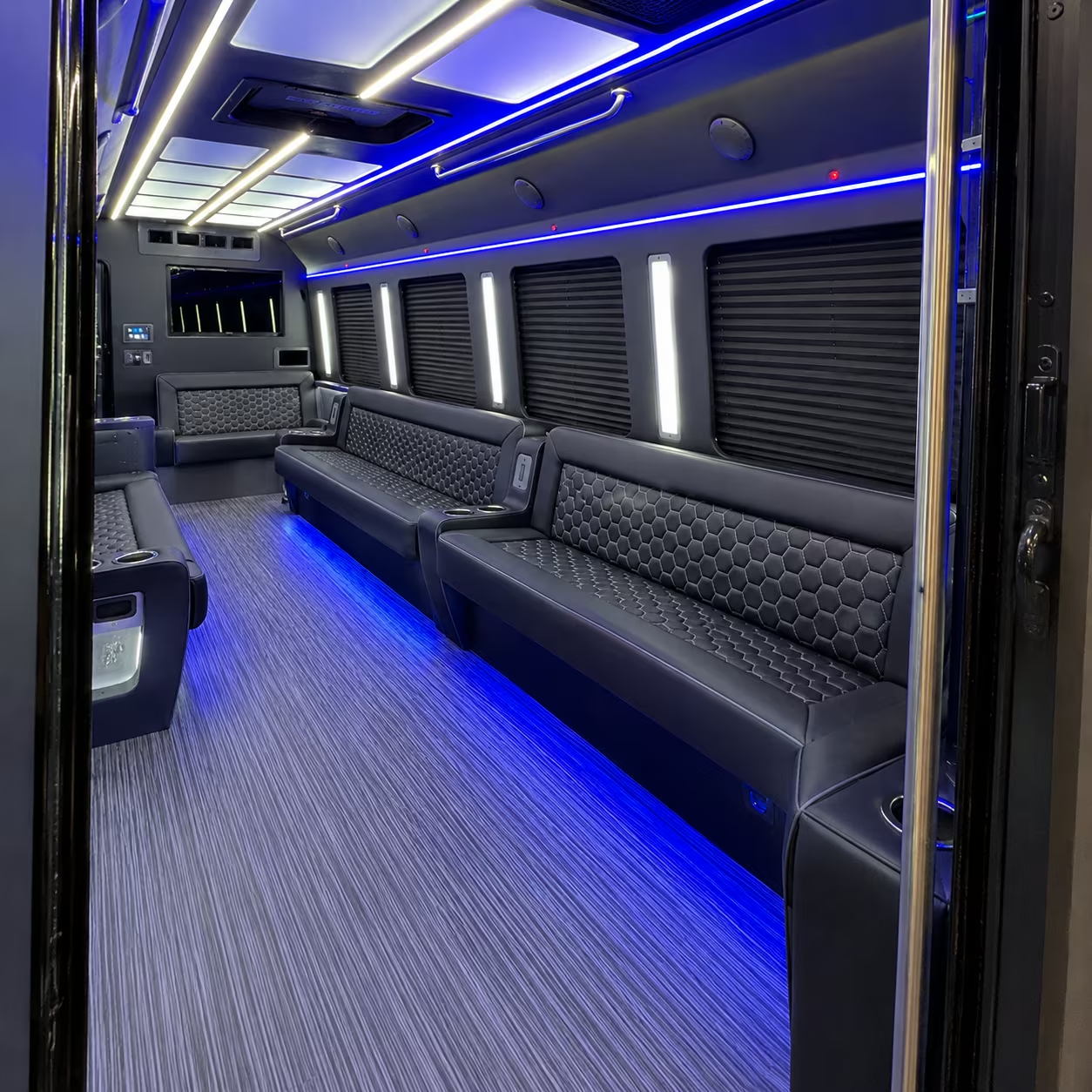
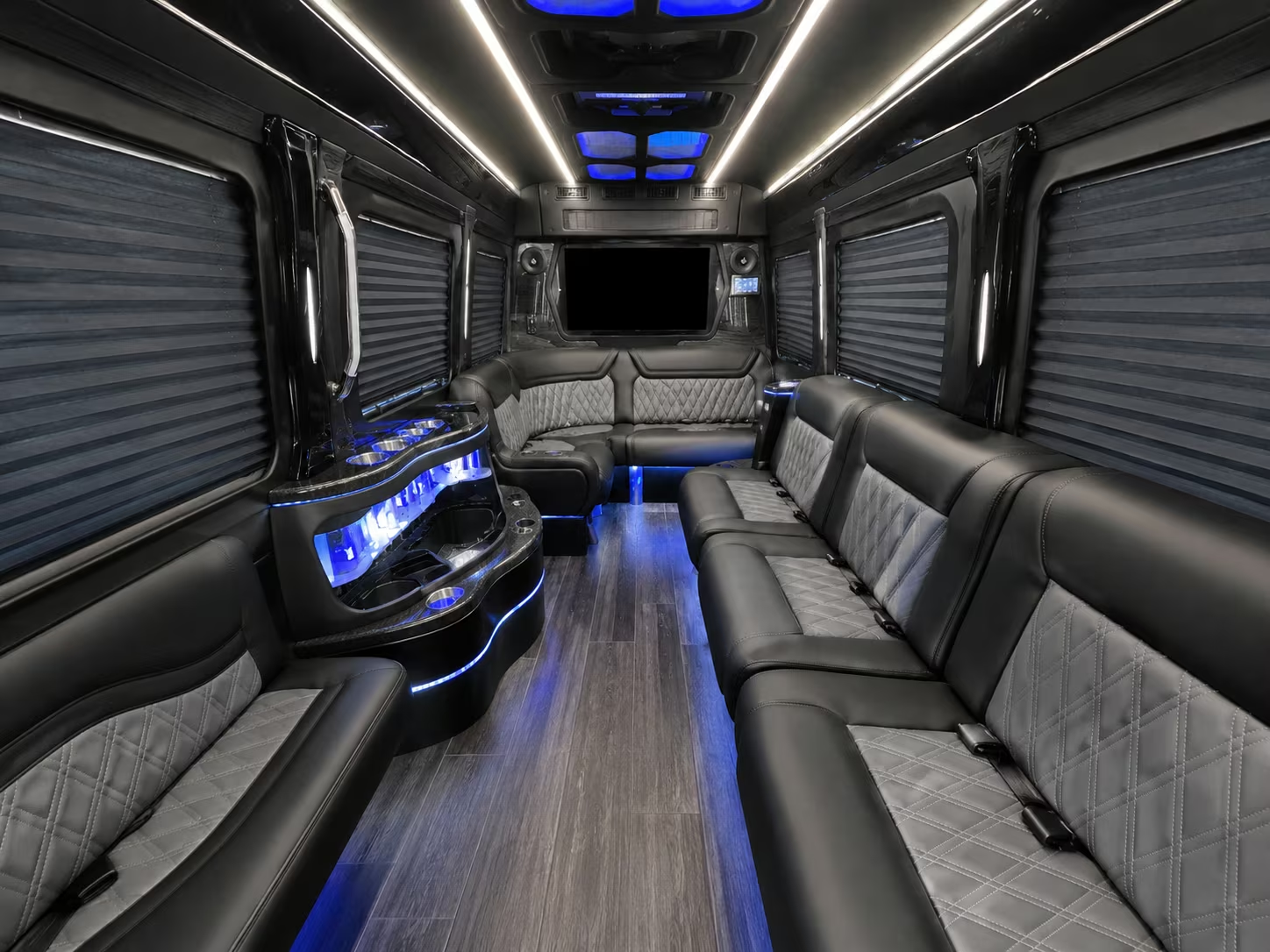
For a group of 10 to 20 people — a suite group, a work outing, or a birthday run down to a Wizards game — a 15- to 35-passenger minibus is the right fit. Minibuses handle DC's tighter downtown streets with more maneuverability than a full-size coach, seat everyone comfortably with reclining seats and strong A/C, and park more easily at Union Station's bus deck. For groups wanting the pregame energy to build on the ride down — a fan group, a bachelor party catching the Capitals, a birthday group — a 25-passenger party bus or larger brings LED lighting, premium sound with Bluetooth, and flat-panel TVs along for the 40-mile corridor.
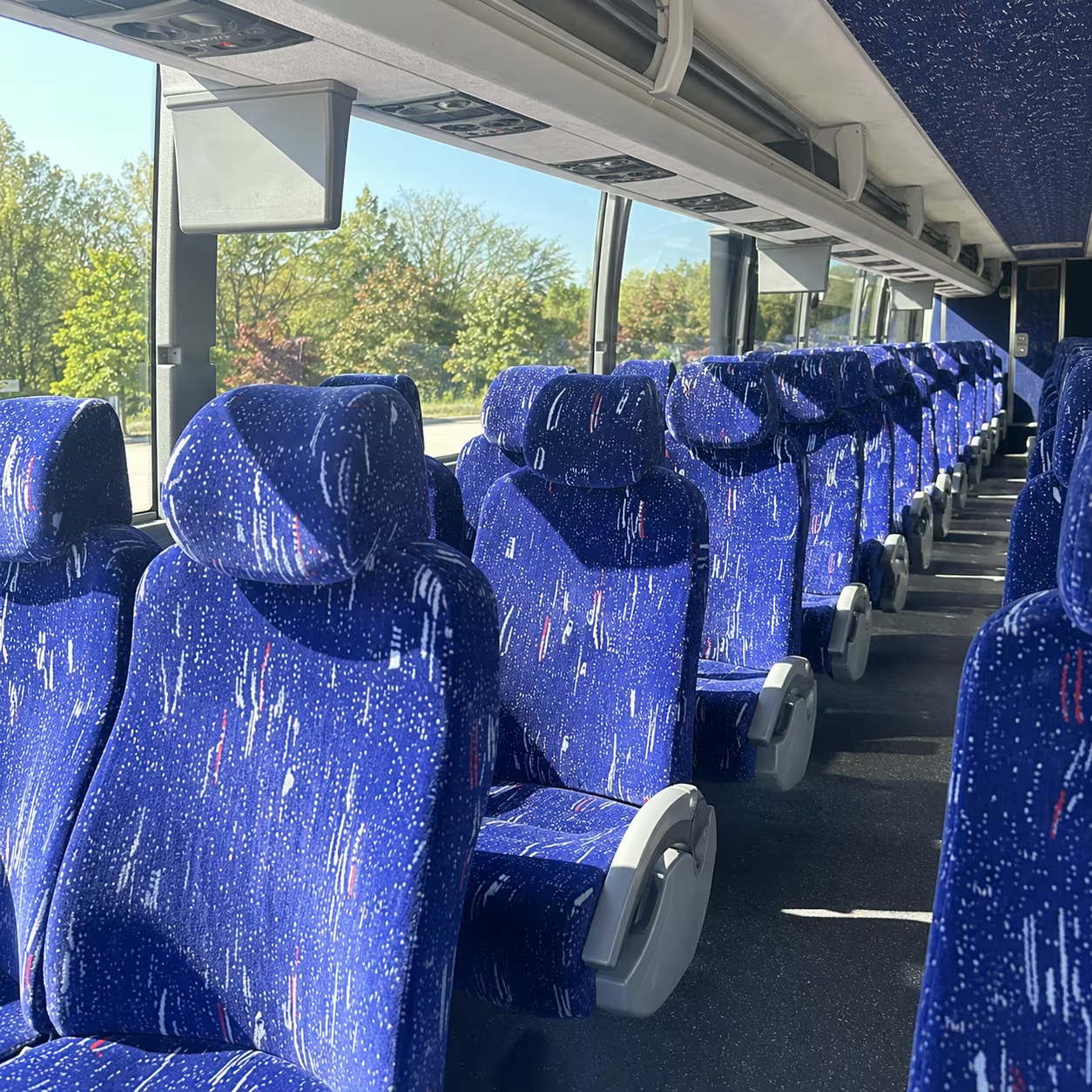
For the biggest outings — a corporate block, a multi-family group, an office heading to a playoff game — a 40- to 56-passenger charter bus handles the full headcount in one vehicle with deep undercarriage storage for gear and bags, reclining seats, overhead storage, and an onboard restroom for the round trip.
For a small VIP group or executive team, a 14-passenger Sprinter limo or Sprinter van is compact enough to pull directly to the F Street curb without the staging logistics of a full-size coach — and easier to reposition during the event in Penn Quarter's narrow grid. ADA-accessible vehicles are available through the network; note it when you request your quote.
Capital One Arena Charter Bus & Party Bus Rental Pricing for Baltimore Groups
Rental rates for the Baltimore-to-Capital One Arena run are shaped by the vehicle size, the total hours the bus is held for your group (including the drive down, staging time, the event itself, and the return to Baltimore), your specific event date, and your Baltimore pickup location. To give you an idea of the planning ranges: a minibus rental runs roughly $200 to $275 per hour on weekdays and $200 to $275 per hour on weekends; a 40-passenger party bus runs roughly $300 to $350 per hour on weekdays and $325 to $500 per hour on weekends; and a 56-passenger charter bus runs approximately $200 to $350 per hour depending on the day and demand. These are planning ranges — your actual quote moves with the specific date, event, vehicle, and total trip hours.
A realistic Capital One Arena run from Baltimore typically covers 5 to 7 hours of total bus time: the 45-to-90-minute drive south, staging at Union Station during the event (2 to 3 hours), and the return drive north. For a 30-person group on a Saturday night, a 30-passenger party bus at weekend rates might come to roughly $1,800 to $2,500 for the full trip — around $60 to $85 per person once you split it across the group. Compare that to three or four people per car, $90 to $140 in parking, and the post-event rideshare scramble, and the math shifts quickly.
Check the Baltimore party bus prices page for more on current planning ranges, or call 410-844-4136 for a quote specific to your group size and date.
One practical tip: Capitol Hill security events, Inauguration traffic, and major DC protests can push demand for buses on the Baltimore-DC corridor well above normal. If your date is close to any major national event, booking early is essential — availability gets thin fast on the most in-demand weekends.
Capitals, Wizards, Georgetown, and Concerts: What the Event Calendar Means for Your Group
Capital One Arena averages roughly 220 events a year across all four of its main draws, and the logistics vary just enough by event type to be worth knowing before you book.
Washington Capitals (NHL). The Capitals' regular season runs October through April, with the densest stretch of home games falling from November through February. Playoff games — and the Capitals have gone deep more than once since their 2018 Stanley Cup run — push demand for buses on the Baltimore-DC corridor sharply higher, and post-game Penn Quarter is at its most congested after an overtime finish on a Friday night.
For playoff dates, book as soon as the series is confirmed; inventory moves fast on the whole corridor.
Washington Wizards (NBA). The Wizards share the building on a calendar that overlaps significantly with the Capitals. Weeknight games are the most common booking pattern — a 7 p.m. tip means a Baltimore group should depart no later than 5 p.m. to absorb I-95 rush hour comfortably.
Post-game finish is typically around 9:30 to 10 p.m., putting the return up I-95 squarely in the lighter traffic window.
Georgetown Hoyas Men's Basketball. Georgetown has played home games at Capital One Arena since it opened as MCI Center in December 1997 — moving downtown after years at Capital Centre in Landover — making this one of the longer-standing college programs anchoring an NBA/NHL arena. Big East matchups in February and the Big East Tournament in March draw strong group bookings from Baltimore; the arena fills to a smaller configuration for Georgetown games but the Penn Quarter logistics are identical.
Concerts. Capital One Arena runs major touring acts nearly year-round. For concerts, the arena's own garage at 6th Street NW does open — the only event type where it does — which slightly eases the parking pressure but doesn't change the core case for a bus.
Concert audiences tend to clear the building more slowly than sports crowds, which means the post-event F Street pickup can take a few extra minutes as the sidewalk crowd disperses. Keep that in mind when you set the post-event staging window. For Baltimore concert transportation, the drop-off logistics at Capital One Arena are the same regardless of who's on stage.
Returning to Baltimore After a Late Finish
The return trip north is where the case for a bus becomes clearest, and it's the thing most groups don't fully think through when they're booking a ride share to get down there. After a 10 p.m. event final — which covers most Capitals and Wizards games and virtually all major concerts — the options without a bus get complicated fast.
Driving means one person in every car stays sober, navigates Penn Quarter traffic immediately after the event, and then handles 40 miles of I-95 on a late-night return to Baltimore. MARC Penn Line weekend service is helpful but has real limits: the schedule on Saturdays and Sundays ends significantly earlier than the weekday midnight last train, and a 10:30 p.m. event finish does not always connect neatly to available MARC departures. Check the MARC Penn Line schedule on the Maryland Transit Administration website before you rely on it for a late-weekend return — especially after any overtime game that runs past 10:45 p.m.
Rideshare pricing post-event is what it is: DC's post-concert and post-game surge window is one of the most consistent in the region, with wait times and prices both elevated for the 20 to 30 minutes after a sellout clears the building.
With a bus, the return timeline is completely under your group's control. The bus is staged and waiting; your group walks out whenever you're ready, loads up at the F Street curb, and heads north on I-95 while Penn Quarter is still backed up. The return drive from DC to Baltimore runs 45 to 55 minutes in light post-event traffic — typically smoother than the southbound run down because the rush-hour compression has long since eased by the time a 7 p.m. event finishes.
Your group is back in Baltimore around midnight or shortly after on most weeknight and weekend game schedules. That's the return trip without any of the negotiation.
Tips for the Capital One Arena Trip Your Group Should Know
Clear-bag policy: Capital One Arena enforces a clear-bag policy for most events. Small clear clutches are allowed, but backpacks, opaque bags, and fanny packs are not. Plan your group's bag situation before the trip; the undercarriage bays of a full-size charter bus hold whatever can't come through the gates, keeping items secure during the event.
Check the official Capital One Arena information page for current bag policy details before your specific event.
Gallery Place-Chinatown Metro: The station is directly below the arena, which makes it an excellent post-event backup plan if any member of your group gets separated — they can always Metro to Union Station and meet the bus. The station serves the Red, Green, and Yellow lines; Metro hours on weeknights run to 11:30 p.m., and Friday/Saturday nights to 1 a.m.
Pre-booking Penn Quarter garages: If any members of your group are driving separately and meeting the bus in DC, have them pre-book through SpotHero well before event night. Walk-up rates escalate on the night of major events, and garages nearest the arena sell out entirely for playoff games and high-demand concerts.
Security perimeters: Capital One Arena is two blocks from the National Mall and a short distance from several federal buildings. Presidential inaugurations, major protests, and national security events can trigger extended vehicle exclusion zones in Penn Quarter that alter normal drop-off routes. If your trip date is near any major DC event, check the DC Department of Transportation's resources for any street closures in effect.
Frequently Asked Questions: Capital One Arena Bus Rental from Baltimore
Where exactly does a charter bus or party bus drop off at Capital One Arena?
The primary drop-off is on F Street NW (Abe Pollin Way), the arena's main entrance side, between 6th and 7th Streets NW. The 7th Street NW side is an alternate when F Street is congested. There is no dedicated bus pull-through lane — it's a city curb drop — so exact positioning on a given event night is confirmed when the trip is arranged.
The venue address is 601 F Street NW, Washington, DC 20004; phone is (202) 628-3200.
Where does the bus wait during the game or concert?
Capital One Arena has no on-site bus staging. The standard option is Union Station's intercity bus deck (50 Massachusetts Ave NE), about one mile northeast of the arena. Motorcoach spaces there require advance reservation; rates cited in the CharterUP parking guide run approximately $60 off-peak and $75 during peak season per vehicle.
Your group sets a post-event pickup time and spot before going in so the bus is back at the F Street curb when you walk out.
Is the Capital One Arena parking garage available for Capitals and Wizards games?
No. The arena's own garage at 6th Street NW is open for concerts only — not for hockey or basketball games. For games, your group uses independently operated private garages in a 2-to-10-block radius, where event-night drive-up rates typically run $25 to $45 per car. A charter bus or party bus eliminates this cost entirely.
Can a full-size charter bus reach Capital One Arena from Baltimore via the Baltimore-Washington Parkway?
The BW Parkway's National Park Service section prohibits commercial trucks on its southern portion, and the American Bus Association advises commercial operators to use the DDOT Truck and Bus Map for DC routing. I-95 South to I-395 North is the standard route for group buses from Baltimore — more lanes, a more direct connection to downtown DC, and a more predictable timeline for event-night departures.
How long does the drive from Baltimore to Capital One Arena take?
Off-peak, roughly 45 to 55 minutes via I-95 South and I-395 North. During weekday evening rush (4 to 6:30 p.m.), the same route can push past 90 minutes, particularly at the I-95/I-495 interchange in College Park. For a 7 p.m. event, departing Baltimore no later than 5 p.m. is the safe call.
Weekend afternoon games typically run 50 to 65 minutes.
How far in advance should we book a bus for a Capitals playoff game?
As soon as the series is set. Playoff games are the single highest-demand dates on the Baltimore-DC bus corridor, and available vehicles at the right size go fast — especially on a weekend. For regular-season games, two to four weeks of lead time is workable; for playoff and finals dates, book immediately.
Call 410-844-4136 to check availability for your date.
What's the best way to return to Baltimore after a late-night event at Capital One Arena?
With a bus pre-arranged. The bus stages at Union Station, returns to F Street when your group exits, and heads straight up I-95 — typically 45 to 55 minutes back to Baltimore in post-event light traffic. MARC Penn Line weekend service ends earlier than the midnight weekday last train, making it unreliable for a 10:30 p.m. or later finish.
Check the MARC Penn Line timetable for current weekend last-departure times before you rely on it for a post-game return.
How does a Baltimore charter bus rental to Capital One Arena compare in cost to driving?
For groups of 15 or more, the per-person comparison usually favors the bus. Three or four cars from Baltimore paying $25 to $45 each in Penn Quarter parking, plus tolls and gas, plus post-event surge rideshare, adds up fast. A 30-passenger party bus for a 5-to-6-hour Saturday night run might come to roughly $1,800 to $2,500 total — split across 30 people, that's $60 to $85 per person covering the full round trip.
Check current pricing ranges on the Baltimore party bus prices page or call 410-844-4136 for a quote on your exact group size and date.
Is Metro a good option for a Baltimore group heading to Capital One Arena?
For a small group (2 to 4 people) going to a weekday game with an early finish, the MARC Penn Line to Union Station and two Metro stops to Gallery Place-Chinatown is a solid choice. For groups of 10 or more, keeping everyone on the same schedule across two transit systems — especially with a post-event crowd and a late-night return window — is where coordination starts to break down. The bus handles both directions in one vehicle on your schedule.
Book Your Capital One Arena Bus Rental from Baltimore Today
Whether it's 18 people heading down for a Capitals Friday night game, a 40-person corporate outing to a Wizards tip-off, or a full-size group for a sold-out arena concert, Partybusrentalbaltimore.com makes it easy to compare party buses, charter buses, minibuses, and Sprinters from a large network of bus companies serving Baltimore. Fill out the quick quote form to see pricing in under 30 seconds — no account, no commitment — or call 410-844-4136 any time to talk through your group's date, size, and itinerary. The bus drops your group at the F Street entrance, handles the Penn Quarter logistics, and has everyone back in Baltimore after the final buzzer.
That's the whole idea.
Also planning a game at M&T Bank Stadium or a night at CFG Bank Arena? The M&T Bank Stadium transportation guide and the CFG Bank Arena guide cover those venue drop-offs in the same detail.